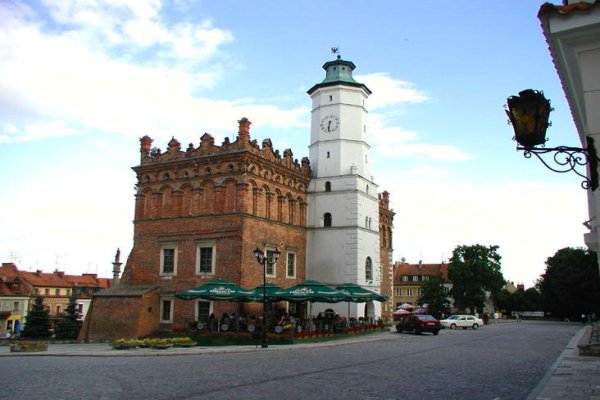
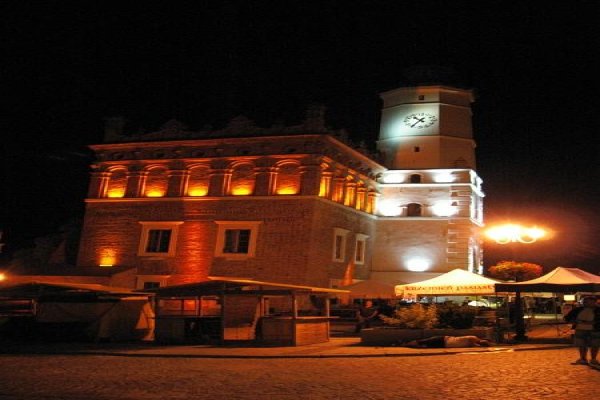
From the outside it looks magnificent, both during the day and at night, when it is fabulously illuminated. And there is something going on around the place all the time.
08.07.2013It's OK
09.07.2012Built in the 14th century, extended in the 16th century (attic), one of the most beautiful Renaissance town halls in Poland. Built in the 14th century originally in the shape of a tower. Expanded inIn the 15th century it acquired an elongated rectangular plan, while in the 16th century it was topped with an attic. At the beginning of the 17th century, a tower was added to the west. The town hall was repeatedly subjected to fires, including in 1623 and 1757. The building is a brick structure. A high attic covers the roof. The plastered tower, with an arcaded entrance to the first floor rooms, is covered with a tin roof and topped with an eagle from the time of the Duchy of Warsaw. Rev. M. Bulinski mentions in the "Monograph" the discovery of a spacious cellar under the City Hall in the 19th century, which was used as a prison. The defendants were tortured in it. This was evidenced by hooks and rings in the walls. The part occupied by the museum presents an exhibition of a historical and artistic nature. The atmosphere of the historic interiors is enhanced by sets of furniture in the late Renaissance, Neo-Renaissance and Neo-Baroque styles. The decor is co-created by documents, city seals, including, among others, the location document of Leszek the Black of 1286, as well as a set of Sandomierz chessmen, dating from about the 12th to the 13th century. The first floor of the Town Hall houses the Historical Department of the District Museum, on the first floor - the Wedding Hall and the City Council chambers, and in the basement - the "Lapidarium" club.
26.08.2011